

Can elastic grinding blocks be used for grinding composite materials?
Hey there! As a supplier of elastic grinding blocks, I often get asked if these nifty tools can be used for grinding composite materials. Well, let's dive right into it and find out!
First off, let's understand what elastic grinding blocks are. They're basically flexible blocks made with abrasive materials. These blocks are super handy 'cause they can conform to different shapes and surfaces. You can check out more about them here: Resilient Abrasive Block.
Now, let's talk about composite materials. Composites are made by combining two or more different materials to get specific properties. They're used in all sorts of industries, from aerospace to automotive, and even in sports equipment. They're known for being strong, lightweight, and having good resistance to wear and tear.
So, can elastic grinding blocks be used for grinding composite materials? The short answer is yes, but it depends on a few things.
One of the key factors is the type of composite material. Composites come in different forms, like fiber - reinforced polymers (FRPs). FRPs can have different types of fibers, such as carbon fiber, glass fiber, or aramid fiber, embedded in a polymer matrix. Each type of fiber and matrix has its own characteristics, which can affect how well an elastic grinding block works.
Carbon fiber composites, for example, are really strong and lightweight. They're used a lot in high - performance applications. When grinding carbon fiber composites, the elastic grinding block needs to be able to cut through the tough carbon fibers without causing too much damage to the matrix. The flexibility of the elastic grinding block can be an advantage here. It can follow the contours of the composite part and apply a more even pressure, reducing the risk of delamination (when the layers of the composite start to separate). You can learn more about our elastic grinding blocks suitable for various applications here: Elastic Grinding Block Ceramic Tile.

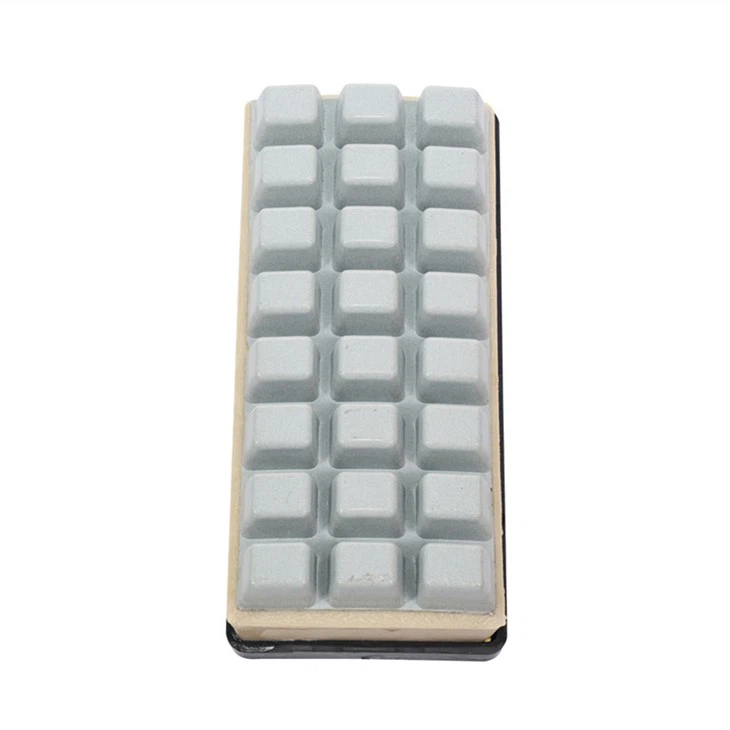
Glass fiber composites are another common type. They're not as strong as carbon fiber composites but are still widely used due to their relatively low cost. Grinding glass fiber composites can be a bit tricky because the glass fibers can be brittle and break easily. An elastic grinding block with the right abrasive grit can help in a smooth grinding process. The flexibility of the block allows it to adapt to the surface irregularities of the composite, which is important for achieving a good finish.
Another important aspect is the abrasive material used in the elastic grinding block. Different abrasives have different cutting capabilities. For example, silicon carbide is a popular abrasive for grinding composites. It's hard and can cut through the fibers effectively. Aluminum oxide is also used, especially for less demanding applications. The choice of abrasive depends on the hardness of the composite material and the desired finish.
The grit size of the abrasive is also crucial. A coarse grit is good for removing a large amount of material quickly, but it may leave a rough surface. A fine grit, on the other hand, is used for finishing and getting a smooth surface. When grinding composite materials, you might need to use a combination of different grit sizes, starting with a coarse grit to shape the part and then moving on to a finer grit for the final finish.
The pressure applied during grinding is also a factor. With elastic grinding blocks, you need to be careful not to apply too much pressure. Excessive pressure can cause damage to the composite material, especially in the case of FRPs. The elastic nature of the block allows for a more controlled pressure application. You can gently guide the block over the surface, letting the flexibility of the block do the work.
In addition to the technical aspects, there are also some practical considerations. Using elastic grinding blocks for composite materials can be more efficient in some cases. They can be used for both hand - held and machine - operated grinding. Hand - held grinding is useful for small parts or areas that are hard to reach with a machine. Machine - operated grinding, on the other hand, is great for large - scale production. You can find our abrasive elastic grinding blocks suitable for ceramic tiles and potentially composite materials here: Abrasive Elastic Grinding Block for Ceramic Tiles.
However, there are also some limitations. Elastic grinding blocks may not be suitable for all composite materials. For example, some composites with very hard and dense matrices may require more aggressive grinding methods. Also, the lifespan of the elastic grinding block can be affected by the type of composite material. Grinding hard composites can wear out the abrasive more quickly.
So, in conclusion, elastic grinding blocks can definitely be used for grinding composite materials, but you need to consider the type of composite, the abrasive material and grit size, the pressure applied, and the practical aspects of the grinding process.
If you're in the business of working with composite materials and are looking for a reliable elastic grinding block supplier, I'd love to have a chat with you. Whether you need help in choosing the right block for your specific composite material or have any other questions, feel free to reach out. We've got a wide range of elastic grinding blocks that can meet your needs. Let's start a conversation and see how we can work together to make your grinding process more efficient and effective.
References
- "Composite Materials: Science and Engineering" by P. K. Mallick
- "Abrasive Machining Technology" by M. C. Shaw